
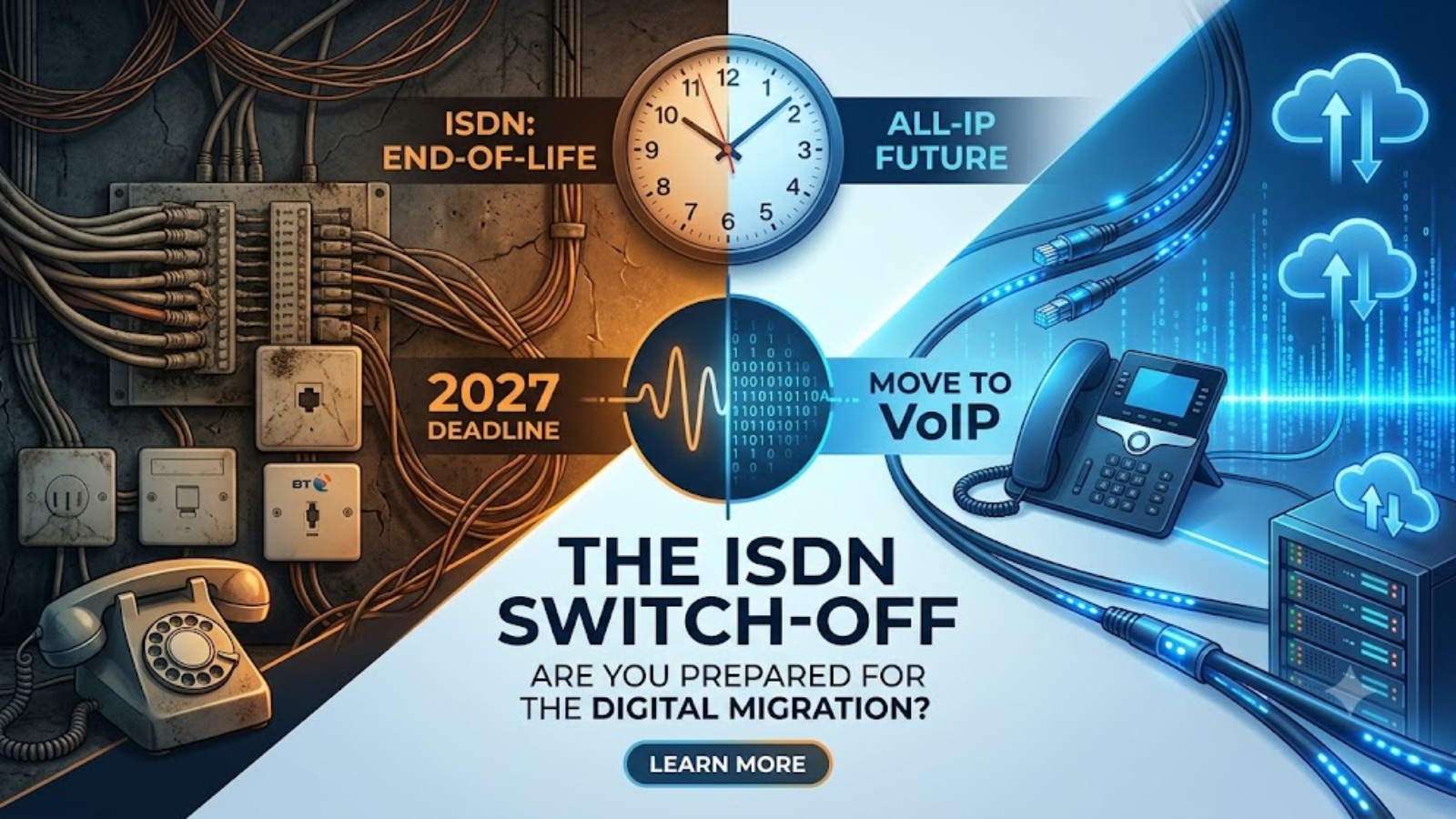
If your business is still relying on traditional phone lines, you likely breathed a sigh of relief when BT Openreach pushed the final PSTN and ISDN switch-off deadline from December 2025 to 31 January 2027.
It’s easy to look at that date and think, “Great, I have time. I’ll deal with it later.”
But treating this extension as a breathing room is a trap. The “stop-sell” on these legacy lines happened way back in September 2023, meaning you can no longer buy new analogue lines or even modify your existing setup. Wholesale prices for remaining legacy infrastructure are climbing, and the deadline is a hard drop-dead date.
If you haven’t fully migrated to a modern, IP-based setup, the clock is ticking faster than you think. Here is what you need to know to ensure your business doesn’t get left in silence.
The Hidden Danger: It’s Not Just About Your Desk Phones
When most people think of the ISDN turnoff, they think of the office phone system. If you’ve already moved your team to hosted VoIP or Microsoft Teams Phone, you might think you are 100% safe.
You might not be.
The PSTN and ISDN network supports an incredible amount of background infrastructure that business owners often overlook. If it plugs into a standard telephone wall socket, it is going to stop working. You need to immediately audit your premises for these hidden culprits:
- Intruder & Fire Alarms: Many older commercial alarm systems use legacy diallers (like dual-path systems relying on an analogue line) to alert monitoring centres.
- Lift Emergency Phones: By law, passenger lifts must have an emergency communication method. A massive percentage of these still run on standard copper phone lines.
- EPOS & Card Machines: Older PDQ payment terminals rely on dial-up lines to process transactions.
- CCTV & Intercoms: Legacy gate entry systems and remote monitoring setups frequently pass data over analogue infrastructure.
If these systems aren’t migrated to digital alternatives—like SoGEA broadband, mobile IoT SIMs, or IP-compatible modules—they will fail the moment the local exchange goes dark.
The Real Risks of Waiting Until the Last Minute
Aside from the obvious risk of losing your phone connectivity and security monitoring, delaying your migration introduces three distinct business risks:
- The Bottleneck: Millions of lines across the UK still need to be migrated. As January 2027 approaches, telecom engineers and hardware availability will become heavily backlogged. If you wait until the final months, you risk sitting in a long queue.
- Escalating Costs: Openreach is actively disincentivising legacy lines. Wholesale prices for traditional copper products are steadily rising throughout 2026. You are essentially paying a premium to maintain an obsolete service.
- Zero Agility: If your business moves premises, scales up, or needs to change its routing, you can’t. Because of the nationwide stop-sell, providers are blocked from making any modifications to legacy lines.
Moving Forward: Your 3-Step Action Plan
Switching to a digital, full-fibre infrastructure doesn’t have to be disruptive, but it does require an organized approach.
- Step 1: Audit Everything. Look beyond the comms cabinet. Walk your building and identify every single device that hooks into a phone socket or relies on an older broadband circuit like ADSL or copper-dependent FTTC.
- Step 2: Check Your Connectivity. VoIP and cloud communication require reliable internet. Ensure your building has access to modern, standalone data lines like FTP (Full Fibre) or SoGEA (which delivers superfast broadband without needing a traditional phone line bundle).
- Step 3: Move to a Hosted Unified Solution. Transitioning to a modern cloud communication platform isn’t just about compliance—it’s an upgrade. Hosted VoIP and cloud-based systems allow your team to take calls seamlessly from anywhere, integrate with your CRM, and completely remove the need for expensive, on-premise hardware maintenance.
Don’t Wait for the Disconnect
The 2027 deadline is firm, and the network changes are already happening region by region. Taking action now protects your business continuity, slashes legacy line rental costs, and ensures your infrastructure is future-proof.
Not sure if your alarms, lifts, or lines are ready for the switch? Contact our team today for a comprehensive communications audit.